

'/%3E%3Cpath%20fill='%23b2b2b2'%20d='M241%20382q0%2016%2017%2026%2017%2011%2042%2011t42-11q16-11%2017-26V269H241'/%3E%3Cpath%20fill='%239f7e00'%20d='M241%20379q0%2014%208%2023%209%209%2021%209%2014%200%2021-9%209-9%209-23V269h-59'/%3E%3Cpath%20d='M241%20339v-70h59v110q0%2014-9%2023l-6%205v-68h-15v72q-8%200-14-4v-68zm59%2040c0%2022%2015%2032%2029%2032%2021%200%2030-18%2030-32v-40h-59'/%3E%3Cpath%20fill='%239f7e00'%20d='M266%20277v5h2v12h-3v-5h2v-5h-9v5h2v5h-4v9h3v18h-5v10h34v-10h-5v-18h3v-9h-4v-5h2v-5h-9v5h2v5h-3v-12h2v-5zm42%20101q0%2010%206%2017%206%206%2015%207%2010-1%2016-7%206-7%206-17v-29h-43'/%3E%3Ccircle%20fill='%230044ad'%20cx='329.5'%20cy='372'%20r='6'/%3E%3Cellipse%20fill='%230044ad'%20cx='300'%20cy='340'%20rx='16'%20ry='21'/%3E%3C/svg%3E)
The concepts of digital sovereignty and strategic autonomy are no longer confined to expert circles. Today, they have become part of the everyday language of public administrations. More and more municipalities are implementing digital strategies, deploying smart city platforms, adopting open-source software, or reviewing where their data is hosted.
All of these initiatives are necessary. However, they are not sufficient.
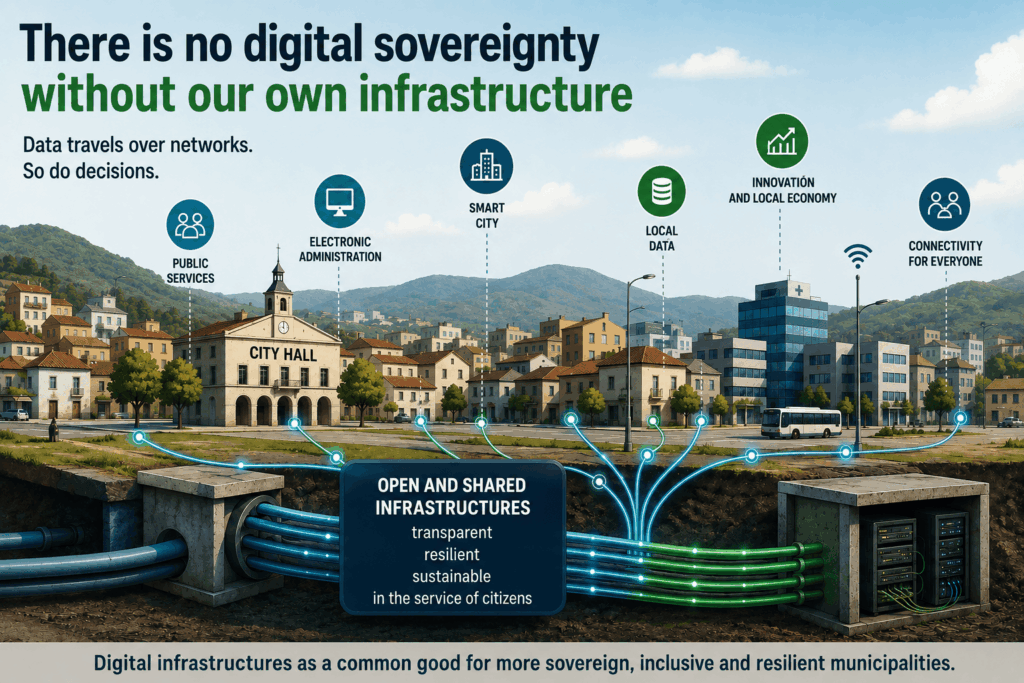
Digital sovereignty does not begin in the cloud. It begins much earlier: with the infrastructure that carries our data.
Infrastructure is political too
When a local government talks about digital sovereignty, it usually asks questions such as: Where is our data stored? Which software do we use? Who controls the digital platforms we rely on?
These are important questions, but there is another one that is rarely asked:
Who controls the network through which that data travels?
Connectivity is the first layer of every digital service. Without a robust, open and accessible communications infrastructure, any digital transformation strategy ultimately depends on decisions made by others.
Infrastructure is not neutral. It determines who can innovate, who can deliver services, what costs municipalities must bear, and how much control they can retain over their digital resources.
Smart Cities need smart networks
Environmental sensors, surveillance cameras, traffic lights, public lighting, smart meters, energy monitoring systems and emergency services all share one essential requirement: a reliable communications network.
Traditionally, these services have been procured independently. Each project deploys its own infrastructure or depends on a specific provider. The result is a city filled with parallel networks that are difficult to interconnect, manage and reuse.
There is another way.
Telecommunications infrastructure can be understood as a shared public asset, much like streets, street lighting or municipal ducts. When infrastructure is open, multiple services can coexist on the same network, reducing costs and avoiding unnecessary duplication.
Open Infrastructure creates autonomy
Having open infrastructure does not mean that a municipality has to become a telecommunications operator.
It means providing a common infrastructure on which different actors can deliver services under transparent and non-discriminatory conditions.
This approach offers several advantages. It encourages competition among service providers, reduces dependency on a single operator, maximises the value of public investment, supports local innovation and strengthens the resilience of communications networks.
It is a way of understanding digital infrastructure as a public-interest asset.
Sovereignty is also built locally
Municipalities are responsible for many public services that now depend on reliable connectivity. They should therefore also play a role in planning and governing digital infrastructure.
Collaboration between public administrations, local communities, network operators and non-profit organisations makes it possible to build networks that better reflect local needs and remain sustainable over time.
The goal is not to replace the market, but to complement it where necessary and ensure that infrastructure serves the public interest.
Digital Sovereignty is about the ability to decide
Digital sovereignty is not only a technological issue.
It is fundamentally about the ability to make decisions.
A municipality becomes more sovereign when it can decide how it connects, how it shares its infrastructure, how it protects its data and how it ensures that digital services will continue to operate in the future.
This capability does not depend solely on software or data centres.
Above all, it depends on having open, shared infrastructure governed according to principles of public interest.
A long-standing debate whose time has come
Over the coming years, municipalities will invest millions of euros in digitalisation, sensors, artificial intelligence and connected public services.
This represents a unique opportunity to broaden the debate on digital sovereignty.
Before asking where our data is stored or which software we use, we should first ask a more fundamental question:
Who owns the infrastructure that makes our digital lives possible?
If we want municipalities that are truly smart, resilient and autonomous, the answer cannot stop at the cloud.
It must begin at street level, where fibre-optic cables, ducts and communications networks connect people, public services and communities.